
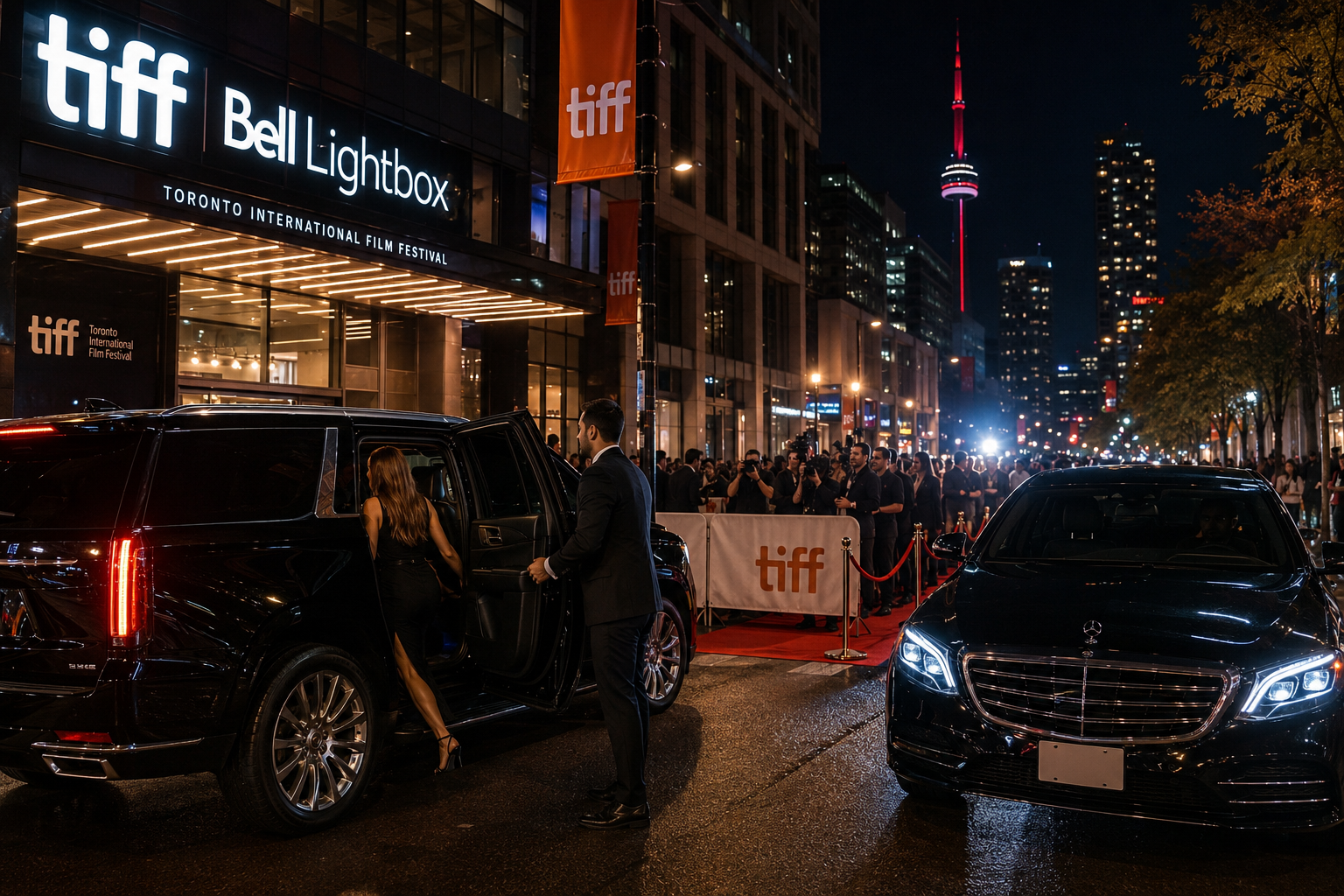
Every September, Toronto turns into a different city. King Street shuts down, camera flashes bounce off glass towers, and for ten days the whole world watches one festival unfold block by block. Anyone who’s tried driving through the entertainment district during that stretch already knows the chaos. TIFF transportation stops being a nice-to-have and becomes the actual line between showing up composed or showing up sweaty, stressed, and twenty minutes late to something that isn’t going to wait for you.
This festival gets bigger every year, honestly. September 10 to 20, 2026 the streets around King, John, and Front fill up with fans, press, industry people, all trying to get somewhere fast. Most folks don’t think about how they’ll move through the city until two days before their premiere, when suddenly there’s no car to be found anywhere near downtown.
Why TIFF Traffic Is a Different Beast
The festival footprint stretches further than people expect once things get rolling. Road closures pop up with almost zero warning and they change depending on which street’s hosting a carpet that night. Rideshare prices spike right when you need a car most. Parking near the TIFF Bell Lightbox is gone early, and some drivers just won’t take short trips through the festival zone not worth their time sitting in that mess.
Had a client last year try booking a rideshare fifteen minutes before a red carpet event on King Street. App quoted him forty minutes and a fare nearly triple normal. Car finally showed up after the carpet had already wrapped. He’d flown in specifically for that moment and missed it by minutes. That kind of story happens every single festival season, which is exactly why people who take this seriously book ahead instead of hoping for the best.
What makes it worse than regular Toronto traffic is how much it shifts day to day. A street that’s clear Monday might be barricaded by Thursday. Drivers who aren’t checking the daily closure updates end up rerouting halfway through a trip, and that burns time nobody has to spare during festival week.
What VIP Transportation Actually Looks Like During TIFF
People tend to picture VIP transportation as something only celebrities get. Not really true anymore. A proper TIFF limo service Toronto relies on has become pretty standard now for executives, sponsors, media crews, even tourists who’d rather not fight an unfamiliar city while it’s this crowded.
A few things that separate real VIP service from a standard car ride:
- Drivers who already know the closures before they happen, not after
- A car that shows up early and waits instead of circling the block
- Actual privacy for calls or just catching your breath between events
- Someone who looks the part when cameras are around
- A driver willing to adjust when a screening runs long, because it usually does
Airport Runs During Festival Season
Pearson gets noticeably busier the week TIFF starts. Flights from LA, New York, London a steady stream of festival-goers landing all at once, especially that opening weekend. Booking a TIFF luxury car service ahead of time means someone’s already tracking your flight, adjusting for delays, waiting curbside instead of you standing outside baggage claim hoping a car doesn’t cancel on you.
This matters more than people think it will. Landing after a long flight, half-asleep and jet-lagged, then spending forty-five minutes hunting down a ride? Rough start to a trip you’ve been looking forward to for months. Had more than one client mention the airport pickup alone made the whole booking worth it, just for taking that headache off their plate before the festival even began.
Corporate and Group Travel Needs
TIFF isn’t just about people traveling solo. Studios, PR agencies, sponsors they’re regularly moving groups of six, ten, sometimes fifteen people between screenings and after-parties on a tight clock. This is where organized TIFF event transportation actually earns its keep one contact, one schedule, cars arriving and leaving together instead of everyone scrambling separately.
A coordinated fleet fixes this cleanly. One contact, one schedule, cars arriving and leaving together. For companies bringing talent or clients to the festival, organized TIFF luxury transportation isn’t some fancy add-on it’s just basic logistics that saves everyone a massive headache down the line.
Common Mistakes to Avoid
Waiting until the last week to book availability disappears fast once the schedule goes live, and prices climb right alongside it.
Assuming a rideshare app will “just work.” Surge pricing and cancellations become the norm near King Street West once evening rush hits.
Skipping the closure maps. TIFF publishes these ahead of time, and drivers who haven’t checked them burn time nobody’s got.
Booking something too small. Garment bags, equipment, extra passengers a compact sedan won’t cut it once everyone piles in.
Forgetting the ride home. People plan arrivals down to the minute and completely forget getting home from a late after-party is its own kind of chaos.
What Nobody Tells You About Red Carpet Timing
Red carpet arrivals run on their own clock, and it’s got almost nothing to do with when the film actually starts. Photographers, security sweeps, step-and-repeat lineups they all follow an internal timing that has nothing to do with the screening schedule. This is exactly why TIFF red carpet transportation needs a driver who understands festival pacing, not just city traffic. A driver who doesn’t get that will drop you off too early, leaving you standing around awkwardly, or too late, missing the window entirely. Experienced chauffeurs build buffer time in for exactly this reason.
Making TIFF 2026 Easier on Yourself
Toronto during TIFF is genuinely one of the best places to be in September. The energy on King Street, the buzz outside the Lightbox, that feeling that something big is happening exactly where you’re standing. None of it means much if you’re spending the whole time stressed, checking your phone every five minutes wondering where your ride actually is.
Booking early, picking a service that actually gets festival logistics, treating transportation like part of the plan instead of an afterthought that’s what makes the real difference here. I’ve watched it play out both ways with clients. The ones who booked ahead actually got to enjoy their festival. The ones who didn’t spent half their trip staring at a rideshare app that kept canceling on them.
If you’re heading to TIFF 2026, don’t leave your ride to chance. These streets get busier every single year, and this one’s not going to be any different.
Ready to book your festival transportation? Reserve your vehicle early and skip the September scramble entirely.
FAQs
Q: How far in advance should I book transportation for TIFF 2026?
A: Three to four weeks out is ideal, especially if you need coverage for the full ten-day window or multiple vehicles for a group.
Q: Are rideshare apps reliable during TIFF?
A: Not really. Surge pricing, cancellations, and road closures near the festival zone make them unpredictable during peak hours.
Q: Can I book a vehicle just for red carpet events?
A: Yes, single-event bookings work fine, though multi-day packages usually offer better value if you’re covering several screenings.
Q: What areas does TIFF traffic affect most?
A: King Street West, John Street, and the blocks around the TIFF Bell Lightbox see the worst closures and congestion.
Q: Is airport pickup included in TIFF transportation packages?
A: Most providers offer it as an add-on or standalone service, with flight tracking included so drivers can adjust for delays automatically.
