
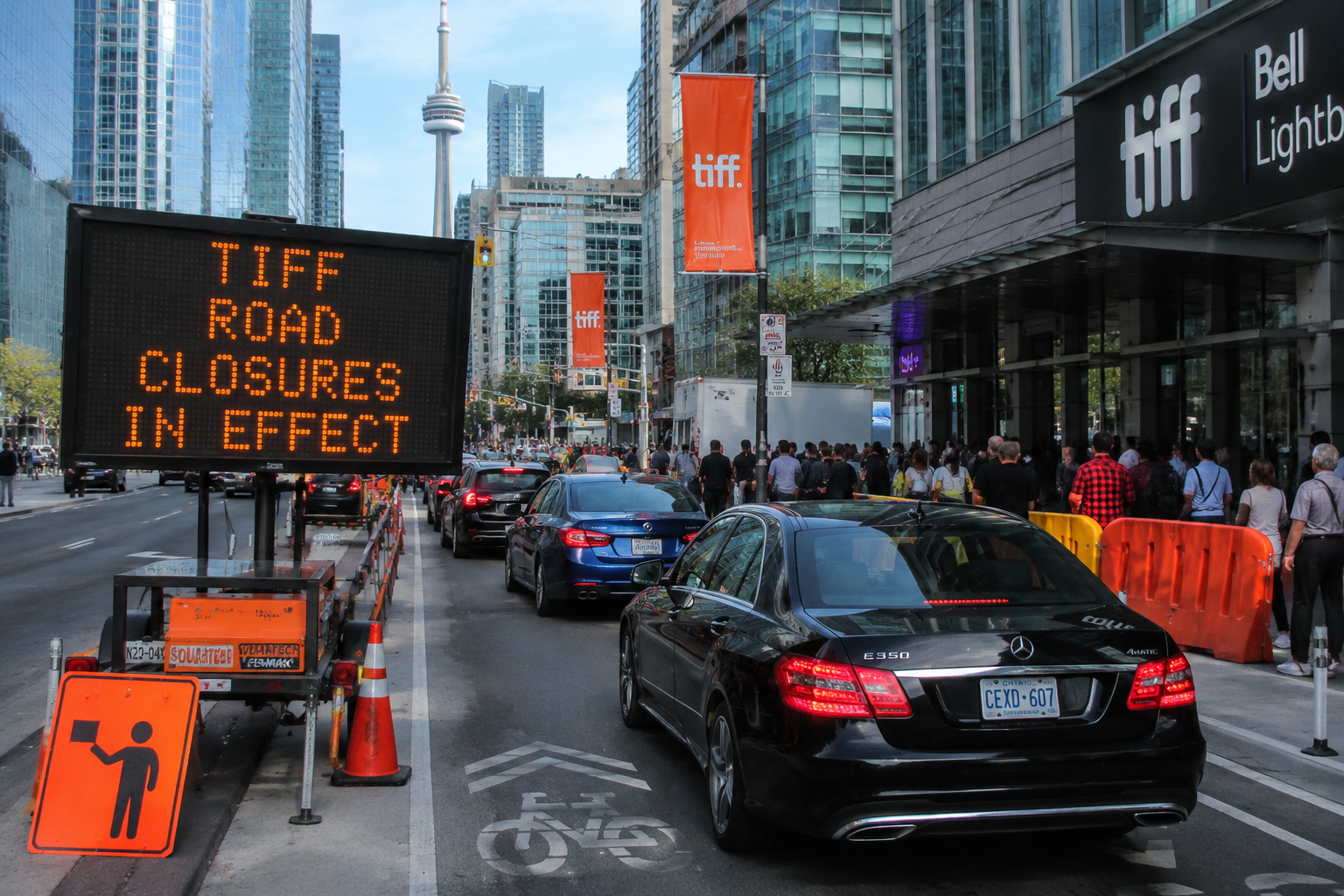
Ask anyone who’s lived downtown through a September festival season and they’ll tell you the same thing the city just feels different. Streets that were fine on a Monday get barricaded by Thursday. Sidewalks fill up with people who clearly aren’t locals, camera in one hand, festival pass in the other. That’s why King Street TIFF 2026 closures are something Toronto drivers need to start planning around now, not the week it starts. I’ve spent more festival nights than I can count parked outside the Lightbox waiting on clients, and there’s a pattern to it. The people who plan ahead get to actually enjoy the movies. Everyone else ends up white-knuckling it through detours, checking the clock, hoping the next light turns green fast enough.
The Map Changes Fast, and It Keeps Changing
King Street West usually takes the hardest hit stretches of it close off completely for red carpet nights, sometimes with barely any notice beyond what gets posted a day or two out. Side streets near the Lightbox and Princess of Wales fill up with production trucks and media vans well before the “official” closures even get announced. Toronto Police typically drop the closure map a couple weeks ahead of opening night, but honestly? The real congestion starts creeping in earlier than that. You’ll notice it in the curb space that disappears, the loading zones that suddenly aren’t loading zones anymore.
Drivers should expect detours along Wellington, Front, and Simcoe once evening screenings ramp up. And if you’re banking on the streetcar to save you good luck. The King line gets rerouted constantly during festival week, and what should be a quick fifteen-minute hop turns into standing on a platform for half an hour wondering if you picked the wrong night to skip the cab.
Where Things Actually Get Stuck
Red carpet arrivals cause more disruption than most people expect, and not just on the block where the event is happening. Police stage vehicles two or three streets out, pedestrian barriers go up early, and suddenly your normal walking route is gone too. If you’ve got tickets for a 7pm screening and there’s a premiere happening nearby at 6:30, don’t assume your usual path is open. Give yourself extra time twenty-five minutes, maybe more on a Saturday when the crowds double.
Then there’s TIFF Bell Lightbox parking, which deserves its own warning label at this point. Garages near the venue fill up shockingly fast, and the lots that stay open start charging festival rates the second the schedule drops. I’ve had clients circle the same three blocks for twenty minutes, cursing under their breath, before giving up and calling me instead. My honest advice: don’t even try. It’s one mistake I watch people repeat every single year.
What Locals Actually Do Differently
The people who handle TIFF well stop thinking about driving to a venue at all. They think about getting dropped there instead. A black car service Toronto regulars already use for exactly this kind of chaos takes the whole parking problem off the table no circling blocks, no anxiety about meters, no walking six blocks in heels because the nearest garage was full an hour before your screening. You just get out at the door.
For anyone flying in for the festival, booking a TIFF airport transfer ahead of time solves a completely different headache. Pearson traffic on its own is bad enough mix that with downtown closures and a driver who doesn’t know which streets to skip that particular night, and a thirty-minute ride turns into ninety. A driver who actually works TIFF season year after year isn’t just following GPS. They’re already three moves ahead, adjusting before the delay even shows up on the map.
Schedules Never Stay Put During Festival Week
This part rarely gets mentioned, but it matters more than people think TIFF schedules shift constantly. A screening moves up an hour. An after-party runs way past when it was supposed to end. A red carpet you had no idea about closes off the exact block you needed. It’s exactly why booking an hourly as-directed chauffeur makes more sense than locking in one pickup and one drop-off. Your driver waits, adjusts, and follows wherever the night actually goes instead of where the schedule said it would.
I’ve watched industry guests hit a premiere, an after-party, and a late dinner reservation all in one evening using this setup, without once thinking about parking or standing outside in the rain trying to flag a cab. During TIFF, that flexibility stops being a nice extra. It becomes the difference between a smooth night and a stressful one.
Mistakes People Keep Making Anyway
The biggest one, by far, is trusting Google Maps to just figure it out. It won’t not reliably, not during a week when closures shift hour by hour based on event schedules that half the app doesn’t even know about yet. Second mistake: underestimating foot traffic. Streets that technically stay open to cars still slow to a crawl because pedestrians spill off the sidewalks and into the road. And the third one, which honestly should be the easiest to avoid leaving for a screening at the same time you’d normally leave on a random Tuesday. During TIFF, “normal” travel time just doesn’t exist.
For the actual official updates, check the City of Toronto’s road restrictions page and the Toronto Police Service traffic advisories once dates are confirmed. Bookmark both before the festival starts. Not after you’re already stuck somewhere with no signal and a screening starting in ten minutes.
Before You Head Downtown
TIFF really is one of the best weeks this city puts on but only if you’re not losing half of it sitting in traffic, wondering if you’ll make the opening credits. Give yourself more time than feels necessary. Know which blocks are likely to shut down before you’re already on them. And if it’s an option, let someone else deal with the driving. It changes the whole experience. Book your ride early, keep half an eye on the closure updates as they roll out, and build in the buffer this city demands every single September.
Skip the TIFF traffic altogether book your ride before the closures hit.
Frequently Asked Questions
When do TIFF 2026 road closures typically start?
Usually a few days before opening night, with things getting noticeably worse around red carpet premieres King Street West and the surrounding entertainment district take the brunt of it.
Is it better to drive or take transit during TIFF?
Honestly, neither is a sure bet. Transit gets rerouted constantly, and driving means dealing with closures and next-to-no parking a lot of festival-goers just switch to a chauffeured black car service instead of fighting either option.
How early should I book a TIFF airport transfer?
Sooner than you’d think. Drivers who know the festival can reroute in real time, but the good ones book up fast once festival dates are announced.
Can I count on finding parking near TIFF Bell Lightbox?
Not really. Lots fill up early and prices jump the moment the schedule drops, so arranging a drop-off tends to be a lot less painful than hunting for a spot.
Why go with an hourly as-directed chauffeur during TIFF?
It gives you room to move when plans shift which they always do without worrying about parking or catching a ride between stops.
